구강 건강의 중요성은 아무리 강조해도 지나치지 않다. 더욱이 최근 구강 건강이 다양한 전신질환과도 밀접한 관계를 지닌다는 사실이 알려지면서 구강 관리의 필요성은 더욱 부각되고 있다.
미국심장협회 학술지에 게재된 2019년도 연구에 따르면 구강 내에서 흔하게 발견되는 세균이 뇌졸중 환자 84%의 두뇌 속에도 존재한 것으로 밝혀졌다. 이는 유해한 구강 세균이 뇌졸중 발병에 일조한다는 것을 의미한다.
또한 잇몸 질환을 앓게 될 경우 혈당 관리에 어려움을 겪을 가능성이 6배나 높아진다고 알려져 있는데, 이를 증명하듯 당뇨병 환자 10명 중 9명 가량은 잇몸 질환, 충치, 구강건조증, 치아 상실을 경험하고 있다. 이처럼 구강 건강과 전신질환은 서로 떼어 놓을 수 없는 관계다.
구강 관리의 기본은 하루 3번 양치질하는 습관에서 시작한다. 그러나 양치질만으로는 구강의 25% 밖에 닦아내지 못하기 때문에 칫솔이 닿지 않는 75% 부분에 수백만 마리의 세균이 남아있게 된다. 따라서 입 속 유해 세균을 제대로 없애려면 양치질과 함께 구강청결제를 사용해 칫솔질 후에도 남아있는 세균을 철저히 소독하는 습관을 가져야 한다.
그렇다면 좋은 구강청결제를 선택하는 기준은 무엇이 있을까. 구강청결제는 제품의 주요 구성 성분에 따라 효과나 치아 변색 유무, 안전성이 완전히 달라질 수 있다. 시중에 판매되는 대다수의 구강청결제 제품은 실리실산멘틸, 유칼립톨, 멘톨, 티몰 등 에센셜오일 성분 기반의 제품과 CPC(세틸피리디늄염화물수화물, 염화세틸피리디늄) 기반의 제품으로 나뉜다.
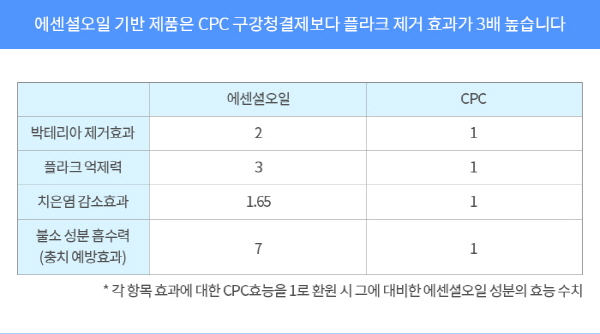
두 제품군에 대해 진행된 연구에 따르면 에센셜오일 성분을 기반으로 한 구강청결제가 플라크 억제력 및 잇몸질환, 충치 예방 효과 등의 측면에서 CPC 기반의 제품보다 효능이 우수한 것으로 알려졌다.
실제로 에센셜오일 기반 제품은 세균이 치아 표면에 달라붙지 못하도록 해 충치를 예방하는 불소흡수율이 CPC 구강청결제 대비 7배 높았다. 플라크 제거 부문에서도 에센셜오일 기반 제품은 CPC 기반 제품보다 3배 더 뛰어난 결과를 나타냈다. 이 외 박테리아 제거는 2배, 치은염 감소 부문 역시 1.65배 가량 효과가 있는 것으로 밝혀졌다.
치약의 계면활성제 성분과 만날 경우 변색을 야기할 수 있는 CPC 기반 제품과 달리 양치 후 사용해도 치아 변색의 우려가 없다는 점도 장점이다.
대표적인 에센셜오일 기반 구강청결제 제품으로는 리스테린이 손꼽힌다. 리스테린은 유칼리톱, 멘톨, 티몰, 실리실산멘틸 총 4가지 에센셜 오일 함유된 구강청결제로 30초 사용 시 입 속 세균 99.9%를 제거하고 그 효과를 12시간 지속하는 효능을 입증 받았다.
이와 관련해 리스테린 관계자는 “구강청결제는 양치질만으로는 완벽하게 케어할 수 없는 구강 위생을 보완하는 역할을 수행한다. 단, 제대로 효과를 보기 위해서는 성분부터 따져봐야 할 것”이라며 “효과와 안전성을 고루 보유한 제품을 선택했다면 올바른 사용법을 지켜 건강하고 청결한 구강 상태를 유지할 수 있길 바란다”고 조언했다.
머니투데이방송의 기사에 대해 반론·정정·추후 보도를 청구하실 분은 아래의 연락처로 연락주시길 바랍니다.
SINGAPORE: Technology - it is one of the few sectors still hiring despite the COVID-19 economic fallout; it is what has enabled many employees to work from home amid the pandemic; it could also displace many jobs over the next few years.
According to the World Economic Forum in its latest Future of Jobs report released in October, half of the businesses surveyed plan to accelerate the automation of jobs in their companies.
Forty-three per cent indicated that they are set to reduce their workforce over the next few years due to technology integration, while 34 per cent said they plan to expand their workforce for the same reason.
"By 2025, the time spent on current tasks at work by humans and machines will be equal," said the WEF report.
Technology-based jobs populate the top 20 in a list of emerging jobs, from data analysts to robotics engineers. Those that are increasingly redundant include accountants, human resource specialists and relationship managers.
The report is based on a survey of senior management leaders from nearly 300 companies worldwide - including 29 with operations in Singapore. Data was collected between January and September this year.
Findings from the World Economic Forum's Future of Job's 2020 report on the top 20 emerging and declining jobs.
So in a future where technology dominates work processes, what do employment prospects look like for people who cannot tell the difference between Python and Java?
It is not necessary for most people to master coding or learn to build software, tech industry players and recruitment experts told CNA, although they noted that it is important to be able to use the latest technological tools that relate to an employee's job function.
Even in a technology firm, non-tech roles like public relations and product design executives will still be necessary in the future - and employees are required to have strong communication skills or a good eye, said Mr Alex Teo, the people experience and government relations lead at online cashback platform ShopBack. It has 150 employees in Singapore and about 500 in nine territories.
Even then, some basic level of coding or data analysis might be required of most of its employees going forward, he said. For example, his finance and marketing teams need to know programming language to enable them to pull out information about transactions or create email newsletters.
“So knowledge of those coding languages … I think going forward. That may be the expectation for (most people),” Mr Teo said.
Similarly, co-founder of digital wealth manager Stashaway Michele Ferrario said many roles in the company do not need technical know-how, such as those in marketing, compliance and client engagement.
Digital tools these departments use, like customer relationship management systems, have also become more user-friendly and intuitive over the years, he added.
Nonetheless, there are business development or strategy positions where data analysis is required and “being able to code will make you faster”, he said.
Stashaway currently has around 130 employees across five territories, with more than half of them in Singapore. Headcount is likely to increase to 200 plus or more than 300 in the next few years, Mr Ferrario said.
Rather than focus on becoming a computing expert, workers should put their energy into finding out how technology will affect their roles and learn to use the latest digital tools, industry players said.
“Tech jobs do not always mean coding or software development. There is a range of jobs in tech, such as product management, digital marketing, data analytics, user experience design (and more),” said Ms Aziza Sheerin, the Asia senior regional director of General Assembly, an educational organisation that runs classes in technology.
“What is important is for people to understand how to leverage tech in their roles now,” she said.
General Assembly's senior regional director of Asia Aziza Sheerin. (Photo: General Assembly)
“I think tech is an enabler, but it doesn't really mean that you have to be a hardcore technical person … the key message is the ability to adapt and change,” said Mr Eric Heung, a manager of supply chain and procurement at recruitment firm Robert Walters. He cited the example of marketing executives who were used to print advertising strategies having to now grasp the idea of social media campaigns.
“If they are not interested in tech, they should still think about how is technology going to change their function, what they're doing, or their industry,” he said.
Ms Feon Ang, LinkedIn’s Asia Pacific vice-president of talent and learning solutions, said the best way to future-proof yourself is to pick up both technical skills and “soft skills” - interpersonal skills related to traits like creativity and persuasiveness.
“Most jobs today require professionals today to possess basic digital skills and we know there will also be demand for professionals with deeper technical skills as businesses adapt to the changing environment,” she said, referring to how COVID-19 has led to a working environment heavily reliant on technology.
Data collected by LinkedIn from its users found that between June and August, software engineers were most in demand in Singapore, based on the proportion of hires with this job title. And among the top three most important skills was the ability to use coding languages JavaScript or Java.
To support such roles, Ms Ang said there will be a need for professionals who are able to conduct collaboration and manage teams across a digital space, which is where the “soft skills” come in.
LEARNING NEW SKILLS
Even before the pandemic hit, some in Singapore have jumped on the coding bandwagon.
Mr Koh Han Seng enrolled in SG Code Campus in March to learn how to use Python and is now in the next level of classes diving into data analytics.
Apart from using his programming expertise to invest in the stock market, the 52-year-old said he took up the courses as he plans to work as a business consultant. The potential new role, he believes, will require him to scrutinise and sort through data.
Ms Siti Herda Nuryani Nasir, a former customer service officer with Singapore Airlines, got herself into General Assembly’s software engineering course in March last year as a way of switching careers.
Like Mr Koh, Ms Nuryani said it was a steep learning curve, jumping into studying something so technical and completely new to her.
What helped to keep them going, they said, was the motivation to learn.
“I have always been interested in programming, (so) I enjoyed all the time I put into practising and learning more about it,” said Ms Nuryani, who is now a junior software engineer at start-up Online Pajak. “I think being able to enjoy what you are going to do most of your time is also really important.”
Previously a customer service officer with Singapore Airlines, Siti Herda Nuryani Nasir is now a junior software engineer at start-up Online Pajak. (Photo: Siti Herda Nuryani Nasir)
Representatives from the schools said it is possible for anyone to become a coder or software developer.
Although having a science, engineering or mathematics background does give students a leg up in the classroom, General Assembly’s Ms Sheerin pointed out that she has seen students from non-technical backgrounds graduate and find a job after that.
One of them was a cabin crew member who studied software engineering and is now a developer at a bank; another moved from being an architect to a user experience designer.
Founder of SG Code Campus Ian Choo agreed that while being more math or science-inclined is helpful in some areas of technology, like machine learning or data science, the outcomes of its three-month boot camps in other aspects like mobile or Web programming is proof that it is possible for anyone to make the switch.
A class conducted by SG Code Campus in February this year. (Photo: SG Code Campus)
“Both competency and interest can definitely be nurtured,” said Ms Sheerin. What her five years at General Assembly have shown is that students need to have enough motivation to see through their training long enough to gain competency, she added.
There is no “cookie-cutter approach” to developing an interest in technology, but taking a broader view of hobbies helps, she said, noting that some people who were very much into playing video games decided they want to build games themselves, while others who were active in community service wanted to figure out how to apply technology to their work.
“I see interest as (something that can be developed) because it’s something that’s within the control of the instructor,” said Mr Choo. “I think it really boils down to - are you convinced that it is useful. And then if you are convinced that it is useful, is it worth your time? And in the process of learning it, do you find it fun?”
Article From & Read More ( As COVID-19 speeds up automation, what does the future hold for non-tech job seekers? - CNA )
https://ift.tt/3mJORlH
Business